Tuesday, February 28, 2017

The zeal of the immigrant: the pain of what we have left behind

I know you might be tired of hearing about immigration. Or if you hear about it you want to focus on the dire situation at hand. I get that, although I'm at a loss personally about what to do short of supporting legal challenges and supporting lawyers waiting to represent people at airports.

Bruno Catalano's immigrant
But I want to explain, as an immigrant, the dynamics of what we feel right now. You've heard of the zeal of the convert. If you convert to a religion, you had to study it rather than being brought up in it, and you're usually more observant than the non-convert. Immigrants are like converts. Most of us chose to come to America. We chose it because it was free, welcoming, and gave us opportunities we couldn't have in our countries of origin. In my youth I briefly thought about immigrating to the United Kingdom. While I still love the UK, I recognized then that even if I went to a top school and got a professional degree there, my professional trajectory in the UK would be limited because being so visibly other would be a continuing obstacle. And for more than two decades I've never had a reason to question my choice of coming to the US instead.

But in choosing to come, we also made a choice to leave. And as complex as our relationships to our countries of origin might be, there is loss in what we chose to leave behind. This sculpture describes it more eloquently than I could. And that hole feels larger every time we are reminded that we are not fully accepted in the country we chose. Every time our loyalty is questioned, despite the active choice we made, somehow it is assumed we are less loyal than those who were born here. Every time we're questioned even if we were born here, because we don't look like the majority of the people who came before, we must be just a little less loyal. That hole keens and aches. And it makes us question whether we were right to set forth, bag in hand, to this land.

Wednesday, February 15, 2017

Cultural appropriation--I get it today

Sometimes realizations come to you at the weirdest times. As the brainstorming facilitators always tell you, there are no bad ideas (well not really), but it is true that insights will come to you on their terms not yours. And yours not to question why.

Karlie Kloss. B-list celebrity. A-list model. Honestly, I couldn't pick her out in a lineup. But she made the news today because she showed up in Vogue in yellowface this month. Not on the cover, mind you, because this apparently marks the first time a real Asian-American has made it on the cover of American Vogue. 

We all borrow culture and history and art. That's what triggers innovation--liminal spaces invite creativity. The Impressionists got huge mileage out of their Japonisme. Kurosawa borrowed time-tested plots and shots from US westerns. The world is richer for all that. It took Karlie Kloss to show me that where cultural appropriation happens is when the borrower is still the only person allowed in the room with that cultural heritage. So Karlie Kloss putting on a geisha shoot in Vogue starts feeling offensive not because of the shoot, but because Vogue is still a place where Asian models are not welcome. So if it takes a white representative to bring that culture in, then yes, it begins to feel like appropriation. 

In contrast, I didn't think the brouhaha over the "Kimono Wednesdays" at  Boston MFA exhibit of Camille Monet's two years ago was really warranted. There's plenty of Asian art at the Boston MFA, Camille Monet was depicting a white woman wearing a kimono, and the Japanese broadcaster NHK had commissioned the kimonos. But today, on Vogue, I got it.

Thursday, April 01, 2010

Innovation: top-down and bottom-up smackdowns


I know I can sometimes come off as ideologically wedded to the bottom-up approach. It's true, I like the idea of bottom-up--it sits well with my own attitude that authority needs to earn respect. There's also some sociological evidence that outsiders are more inclined to come up with breakthrough innovations because they are not caught up in "the way things are done." But for the record, I really like to see these approaches go head to head and the proposition get tested empirically. And in truth, I suspect that one approach may be better for some types of problems, and that while there might be a tilt to one approach or the other from time to time, there will be plenty of counterexamples to "disprove" most rules of thumb. But I had cause to come across 3

One, students from Laval University created a 2487 MPG eco-car. That far exceeds the performance of any eco-car created by professional car manufacturers.

Two, I love to cook, and am a complete devotee of Cook's Illustrated. I also love to read the commentary and inputs and ideas featured on Food 52. When these two beloved institutions decided to run a cook-off, I was in heaven. For non-foodies out there, Cook's Illustrated, run by Christopher Kimball is the gold standard for expert testing. They publish authoritative bibles like The Best Recipe. No hedging, and it's pretty much all invented in Vermont. MIT Poverty Action Lab meets GiveWell. Food 52, founded by Amanda Hesser and Merrill Stubbs, is lightly curated site populated by regularly held contests for the best recipes. So much more like GlobalGiving, or DonorsChoose. I can't wait to find out what happens.

Three, our own GlobalGiving-Innocentive GlobalGiveback challenge sponsored by the Rockefeller Foundation. We're still in the middle of it, but I just heard from the Innocentive folks today that in 3 out of the 5 challenges (they happen to have had earlier deadlines for solutions), solver interest in providing a solution has been 2x what Innocentive sees usually in comparable solutions being sought by for-profit entities. That there's so much pent-up interest in the Innocentive community to contribute to solving social problems confirms my bias that international development has an untapped resource in the broader public. We just haven't made it all that easy for people to contribute.

Thursday, October 29, 2009

Design Thinking, Part II


So my few loyal readers will know that given a choice, I'll always opt for working with my hands--I'll make it or fix it or refurbish it rather than buy it. Mostly because I just like doing things with my hands, and I tend to be pretty good at it.

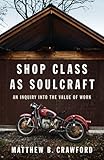
But I've been reading Matthew Crawford's book Shop as Soulcraft lately, and I'm tempted to find even more virtues in the hands-on approach than I was. One important point he makes is that mastery over things is, for better or worse, a key component of our psychological makeup, such that it feeds our spirit (as Eli noted in her comment) and makes us happier, more empowered, and in the end truly creative. (Crawford has some scathing comments to make about the faux creativity of Build-a-Bears and customized Scions).

But the point I want to highlight here, is an implied point. He points out the difference between theoretical and conceptual knowledge (as exemplified by his physicist father) and empirical, real knowledge (as exemplified by his knowledge of his exasperatingly old and dodgy VW bug) and how these two types of knowledge part company. I can draw an analogy to the conceptual knowledge that I used to rely on for my work at the World Bank, and the hard-won empirical knowledge that social entrepreneurs on GlobalGiving use day in and day out.

Crawford's point is that life today provides much less of the latter than it used to, and that it is a dangerous thing--for the spirit, for sustainability, for our ultimate fates. While I don't see a concomitant shift in the development field--having come into existence really in the 20th century it is a product of its time and the lion's share of resources in development are put in service of solutions based on conceptual knowledge--I think the discounting of knowledge on the ground is equally dangerous in development. But like the motorcycle repair guy, most social entrepreneurs just go on about their business without much flash or renown. But they sure make the lives of their community better. They have to--they are right there and either they deliver results, or the community will move on.

Monday, October 19, 2009

A matter of faith

GlobalGiving was founded on the realizations that:

  • there were entirely too many potential social entrepreneurs all over the world that needed to be given a chance to test their idea of fighting poverty

  • for one rock star social entrepreneur, there were probably at least a hundred people who had tried something like, and failed

  • international development badly needed more than one Nobel Peace Prize winner in the sixty plus years since colonialism

  • and try as we might, there was no way for even the best and the brightest to know who would succeed, and who would fail, much less why

So what the world needed was a platform that made it safe and easy for all these bottom-up efforts to be visible and accountable to the outside world, and whose mission it would be to continuously lower the barriers to entry so that we didn't inadvertently leave another Mohammed Yunus stalled for lack of support. Of course, you can argue for development Darwinism, that the social entrepreneurs who aren't crazy or committed enough to keep going against all odds weren't going to succeed anyway--but clearly there are economies in the world that provide a hospitable environment for small-scale businesses and others that do not, and most of the economies that don't pay the price in lower prosperity overall.

So it's my vision for GlobalGiving that we play a small role in making social entrepreneurship just a little less crazy, a little less quixotic, and that we thereby make it possible for more innovation and change to happen in development. We won't know ahead of time what those innovations will be. We won't even know who will lead those innovations. We might know if someone one day can trace a rock star social entrepreneur back to their beginnings on GlobalGiving, but there's no guarantee we will be directly responsible, nor even that they might have succeeded without us. So it comes down to a matter of faith--an ironic position for me, as basically a non-believer with a Buddhist heritage.

This is, of course, a restating of Dennis's latest post (which in turn is really a hat tip to Bill Easterly), but here I am restating what we're about because we had two retreats last week, and in reiterating what inspired us to start GlobalGiving, I was struck by the fact that most of my colleagues encouraged me to state it, and state it again. So here it is.

(It's also a way for me to get back to blogging. I realized how bad it was when I saw that I had unmoderated comments from June--eek. Eli, Dibyendu, my apologies!)

Sunday, June 07, 2009

Design Thinking

Yesterday as I felt compelled to defend why I was repairing my 99 cent gardening gloves instead of buying a new pair, as Dennis suggested, the connection between Depression habits (or, in my case, inherited postwar habits),


, kaizen and design thinking became clear.

I repair stuff instead of throwing them away out of habit and practice, and because being chary with resources is a taught Japanese value. But I persist I'm repairing stuff even though it doesn't make strictly economic sense because I learn a lot when I take things apart or repair them. I either see the bad design or poor workmanship that led to the hole in the first place and know what not to do (gloves case in point) or I marvel at the cunning of the colonial clockmaker, who I think, had to create this Western clock at the behest of a expat colonial client.


And so every time you repair or otherwise take time to get into the guts of something you can see how it was put together and how you can do better--or shamelessly copy, as the case may be. That's the logic behind kaizen, and the logic behind design thinking, as Jocelyn Wyatt of IDEO reminded me last week at the Bankinter forum in Madrid.

(As you see, I'll do anything to defend my own little pastimes and foibles.)

-- Post From My iPhone

Tuesday, May 05, 2009

Truck envy, or the way we justify things

This weekend we had brunch with an old colleague of ours we hadn't seen for over 10 years. What do you know but he's gone and bought a Honda Ridgeline that Dennis has been drooling over for the last year or so. This renewed his sense that a man's entitled to a Honda Ridgeline, but some last doubts remained ... hence the following exchange:

Dennis: I need a truck for my place in WV, I have decided. So I am getting a Ridgeline this week – unless you tell me that a diesel will be out in the fall?
Friend [who is passionate enough about the Ridgeline that he's blogged about it]: >Diesel. Great question. I've heard conflicting reports, that it was coming next year, but also that it has been canceled ... I wish my wife would let me get one... of course, I don't have any reason to own one ... I heard that Tufte owns one!


This is why I love these guys. Anyone who would think of justifying a truck purchase by citing Tufte get my vote.

Wednesday, March 25, 2009

Career advice: Oxford, Akhmatova, and Isaiah Berlin


When people ask me for career advice--and in particular, when they ask me, how can I get to be doing what you're doing--I have a hard time answering that question. Because honestly, I can't say I had any intention to be doing this--say, attending the Skoll World Forum on social entrepreneurship at Oxford--when I first started thinking about my future. Looking back, if this is where I was intending to be, I'd say I had a lot of false starts.

First, my parents, being Japanese, very decidedly mercantile middle class, and pretty old-fashioned, really didn't think I was going to college. (It's one of the reasons I was allowed to attend international schools. If I had been a boy, they would have made a bigger effort to keep me in Japanese schools, and in the Japanese system, studying for the be-all and end-all university entrance exams.)

Then, when I did go to college, I was a Russian history major--when I first fell in love with Isaiah Berlin--and I ended up continuing on to grad school to become a Sovietologist (fully intending to become an academic.) And in fact while I was an undergrad at Harvard I was unhappy enough that I took the Oxford entrance exams--to go study law at Magdalen College. (I got in, but never left Harvard--another false start there).

Then, in 1991, when I was in grad school, the Soviet Union fell apart, and my desire to pursue an academic career in Sovietology evaporated--partly because as Sovietologists we'd signally failed to see the end coming, and partly because the government funding for Sovietology dried up. And that's how I joined the World Bank--as a Russia expert for a new member country. The best part about the job was I got to do what I had intended to do as an academic--to understand, if not undo, the repressions that had stifled all the things I had come to love about Russia, its history, people, and culture.

And ten years later, I left, to start GlobalGiving with Dennis Whittle. And now, eight years after that, it's all come full circle with Kenneth Brecher's incredibly eloquent story about Anna Akhmatova, and how we can but aspire to resemble Isaiah Berlin's description of her devotion to poetry, to witness, and belief in the future. So maybe, next time they ask me, how do I get where you are, I'll take them around the long way--and start with Isaiah Berlin.

Come to think of it, I think it's the first book I lent to Dennis, when I first met him, 17 years ago.

Monday, March 16, 2009

*How* to spend the stimulus bill

Most of the political debate has been about whether we need a stimulus package, whether all the pork has or has not been stripped out of the package, etc. But now that we have a package, the screech of the rubber hitting the road is in the paucity of ideas on *how* to spend the money (not on what, although that's another topic entirely).

But by and large, this isn't a sexy topic. The rules and incentives you set up on spending is the minutiae of bureaucratic work--but as Sir Humphrey Appleby knows well, you can win or lose a lot of battles there. And it's hard to report on. So I was pleased ... until I wasn't, when I heard a story on NPR the other day about how to exercise oversight over spending. The story pointed to the procedures developed at NEA after the Mapplethorpe etc. flap as one way to go. I'm sure I'm not doing the rules justice, but it came down to accepting no applicants who weren't already approved and vetted NEA grant recipients (in other words the usual suspects), and limiting grant requests to 2 sizes--$25,000 or $50,000--to make it easier to process. The commentary in the piece sort of says it all in terms of what bizarre sorts of behavior you could end up with:

But that's one grant protocol that poses a challenge for grant writers. They never want to ask for too little — arts groups are constantly cash-strapped. Ask for too much, though, and they might price themselves out of the competition and get nothing at all. It can be a tricky calculus.

As a good ex-bureaucrat myself I know that rules like this work to get money out of the door faster, and if the money doesn't get out of the door it doesn't have any stimulus effect. But are we reduced to reaching for a process that was developed essentially to prevent public funds from being spent for outre art in figuring out exactly how to spend the stimulus package? I know there aren't easy answers, but this is an unprecedented opportunity/challenge.

Wednesday, March 11, 2009

A nerdy post about book formats

For my birthday last year, I got a Kindle. I toyed with it a bit and still rely on it when I travel, but Dennis has since become the power user of the Kindle. 

Our audible.com subscription account (originally Dennis's) is 5 years old, and I think Dennis got to pick 5 out of the 60 titles. In other words, I took over his audible account.

For my part, both the MP3 books and Kindle struck me as a great way to resolve the dilemma of what books could you not do without on a long business trip or vacation, and having to slight hardcover books because they would weigh you down traversing airports. And now, the idea of being green (and not boycotting bookshelf purchases) makes it even more attractive.

But I've discovered a couple of things about the way I absorb and appreciate narrative. The biggest downside of the Kindle, I found, is that I actually subconsciously recall and organize narrative by the physical progress I make through the book. I'm reading Zadie Smith's White Teeth (***) right now and I realized that I recall that Archie's story comes first, followed by Samad's, by the feel of the bulk of pages in my left hand. I'm also in the middle of John Le Carre's A Most Wanted Man (should be ****, but I'm experiencing it more like ***) on the Kindle, and discovered that I have a hard time recalling what events were revealed in what order--and this is one of my absolute favorite authors, so I really shouldn't have trouble being engaged. Finally, I just finished listening to Carolyn Chute's The School on Heart's Content Road (****)--a lyrical and unironic book written about a politically incorrect outsider community that in MP3 format took 17+hours to get through. But no problem recalling the narrative thread despite not having a book in my hands, perhaps because as I listen to these books I pay more attention (I tend to read very fast visually, whereas listening forces you to a certain pace) and I even remember the order of narrative by where or what time of day I was walking.

Which is all by way of acknowledging that even when it comes to what are arguably much more similar media--physical books and the Kindle--the way my mind processes information has very strong, and unexpected preferences. 

I wonder, even as we rush helter-skelter to a world without physical newspapers, physical bookstores, perhaps one day even no more paper books, whether we'll discover that content is not all, and that form does--or did--matter.

Thursday, November 13, 2008

Drinking your own Kool-Aid


I was recently on a panel for a small dinner focused on international issues at the Indepedent Sector conference in Philadelphia.

The best parts of my brief stay in Philly:
  • spending some time in a small group setting with people who really are plugged into legislative and regulatory developments affecting not only nonprofits generally, but private foundations, international grantmaking, foreign assistance.
  • listening to the story of the ill-fated Carnival Cruises pinata on "Wait, wait--don't tell me," on the drive up to Philly and seeing the un-demolished beast on Broad Street in the rainy dusk (and no, the problem wasn't that they had blindfolded the guy operating the wrecking ball)
  • reminiscing about pre-reform Russia with a fellow conference attendee who lived in Irkutsk in 1990
  • meeting Ami Dar--founder of idealist.org--after many years
The parts that gave me the most pause:
  • there were huge expectations that the incoming administration of President-elect Obama would focus outward--both to respond to international expectations, and because it was the right thing to do. I don't see that happening, for two reasons. One, American power is on a decline right now--it may come back up, but the collapse of the financial sector and the fact that after we emerge out of this tunnel the US may no longer be in a position to lead the world economy by virtue of being a consumption engine--so even with all the expectations that Obama will pursue a much more collaborative foreign policy, he basically has fewere and weaker levers to deliver results. Two, there is equally, if not arguably a much more engaged and vocal constituency back at home that will demand results--and even Obama has only 24 hours a day.
  • there was an implicit consensus on the panel--if not among all the dinner attendees--that internatinal philanthopy could take care of terrorism better than military means had to date. I think the jury's out on that. Whatever you may think about the conduct of the wars in Iraq and Afghanistan, I honestly don't see any evidence that more education, more prosperity, more health services will actually address the origins of terrorist activity. That's giving too little credence to the power of ideology that feeds off of perceived insult.
Which is why I called this post drinking your own Kool-Aid. My whole professional life at this poitn is a commitment to the proposition that international development and philanthropy can make a difference--and that I can make a difference in that effort. But just because I've devoted my life to this doesn't mean I believe I can solve everything through this. That would amount to drinking my own Kool-Aid.

Thursday, July 24, 2008

In praise of cross-platform

So I promised to blog further about Bill's new book Reinventing Aid, and I was catching up on my blog reading today, and this post from Lucy Bernholz struck me as the perfect hook.

in this post, Lucy points out that public goods are no longer provided exclusively by the government (traditionally the financier, if not the provider and distributor of public goods and services.). She calls it "cross-platform" provision and financing of public services. Totally agree, and from my point of view a good thing.

And here's where my point of view comes from. The World Bank--whose mission is to be the funder of public goods globally is an institution modeled on the classic assumption that government is the agency for the financing, provision, and distribution of public goods. Its governance, instruments, everything is aligned against that assumption--whether the government is low on capacity, high on corruption, or both. And even when governments are both competent and trustworthy, they are almost by definition monopoly actors. And monopoly power is a dangerous thing.

For one thing, it makes it really hard to even ask what I think is the key followup question Lucy raises as a follow up to her observation about cross-platform: what is the best (most efficient? most effective? most sustainable?) mix for [any] service? You can't ask that question when there's only one provider. Which is our beef--and our chapter in Bill's book--with the quasi-monopolistic provision of international assistance.

Tuesday, July 22, 2008

Stop the Madness, GlobalGiving style


Yesterday Bill Easterly, one of the first economists I got to know and admired immensely at the World Bank working on Russia, gave a talk at the Center for Global Development about his new book, Reinventing Aid. Bill has since become a valued friend, and it's with both admiration and much gratitude that Dennis and I have contributed a chapter to this book. It's one of the benefits of being part of an edited volume--you can admire the book because of all the other amazing thinkers who contributed to the volume, whose reflected glory benefits your own work, "judged by the company you keep, etc." More on their chapters later.

I'm also pleased to blog about the book because it gives me an excuse to highlight a little known obsession about Robert Dubois and Alison McQuade--some of the youngest and most dynamic staff members we have here at GlobalGiving. You see, to paraphrase Bill, Reinventing Aid is a collection of some of the most interesting thinking around how to "STOP THE MADNESS"--that is, stop doing what we know doesn't work, and start trying something else. And for some reason that I can't fathom--besides the fact that this is one of the most insufferable music videos I've ever seen--"STOP THE MADNESS" is Robert and Alison's favorite video. They love to play it at the end of a long hard day of work and leave us all at a loss as to what draws them to a video that was made just about the time they were born. You can be just as puzzled too--here it is:

Tuesday, July 15, 2008

Working to be disappointed


Some of you know I think Edward Tufte hung the moon on the visual display of information. And I've had serious iPhone envy since it's come out. So imagine my anticipation in seeing this video cited in a New York Times article on how the iPhone has proven that even on the web, less is more.

And here's where this post deviates from the script I'd planned for it ... because I actually don't agree with some of his observations. I actually think the iPhone display of weather is better than what he proposes, and I kinda think his version of the weather violates his own observation about "overload and clutter≠information." As a very wise person once told me, you have to work to be disappointed.

Wednesday, June 25, 2008

Games for Change

The Washington Post covered games for social change lately, which reminded me why I thought they were so cool when I first started seeing them in our sector. From the game inspired by the overthrow of Slobodan Milosevic to Darfur is Dying, to the game where you get to experience what it's like to be a farmer in the developing world, I've thought this was an amazing way to transport people directly into different worlds. At GlobalGiving we tend to stick to First Life most of the time, but occasionally we get lucky. Here's a project to support a game created by HopeLab, which helps significantly decrease the remission rates in young cancer patients. It sets them up as heroes in a game visualizing fighting the cancer cells using the tools in their arsenals.

This might even work as another argument for procrastination. At least you'd be learning something useful in the process ...

Saturday, June 14, 2008

Working within the box and out of the box


Dennis has just blogged about Tim Kane’s observation when he first visited Japan in the 1980s—where he encountered a humbly equipped man sweeping the tarmac at Narita airport as if his life depended on it. Kane linked it to the overwhelming ratio of perspiration v. genius that adds up to excellence.

There's something else there though. It’s symptomatic of how intensely Japanese individuals and organizations have come to focus on discovering value within their constraints. Toyota’s continuous reform (kaizen) program is justly famous for the way they look at change as a continuous stream, but a lot less is said about the implicit mindset that allows for what feeds that continuous stream. It’s the idea of working your framework so intensely and carefully and allowing the individual changes combine and “re” form the whole until you’ve eventually got a different box. But you didn’t start out insisting on getting out the box. In fact, it comes from a culturally mandated willingness to focus intensely on where you are and what you have. (The flip side of course, is that it can drive you mad to be so constrained, but more on that another time.)

What I was saying about the incredible Tokyo discipline to obey what can seem like a pettifogging rule of standing on the left is, I’m convinced, part of the same phenomenon—everyone is intent on getting the most out of every frigging commuting minute. It just wouldn’t happen that way otherwise. Same reason Japanese geeks are the most intense geeks anywhere. Or why Japanese classical concertgoers bring sheet music to performances. And why I am currently obsessed with us doing a better job facilitating the exchange when our project leaders can convey to donors the sense of incredible value and adventure that every project on our site represents. Here’s just a hint of what donors say when when the value gets uncovered. (It’s also why I try to wash and reuse our ziploc bags. It just seems un-Japanese not to.)

Saturday, May 24, 2008

Rules in Japan: II

The other amazing thing about Japan, besides the fact that there are so many rules about what to do and not to do, is how many of them don't have to be written up, let alone have some sort of enforcement mechanism. Take a look at this elevator in the Tokyo See how everyone is lined up on the left? In London, there are signs everywhere about standing on one side to let others walk up the escalators. In Washington, there are no such signs and the local papers are filled with complaints about how people don't remember to stand to one side. In Japan, no signs, no deviations from the rule. Even by unsuspecting tourists. Amazing. But then, take a look at the transportation map (combined metro and trains). Can you imagine navigating that everyday, let alone actually making it run on time? They apologize when their trains are running 2 minutes late.

Tuesday, May 20, 2008

Order in the universe: Japanese style

Every time I come home to Japan I marvel at how they keep this incredibly dense , complex society not only together, but humming at enviable rates of efficiency. Some of it is regulatory-there are rules for everything. But the regs don't always come from the top--the sign above the cat door here says: "Please don't feed this cat. He has plenty to eat inside."

Sunday, May 11, 2008

Only connect: Mother's Farm

Sometimes a donor comment on a project will make me smile. More rarely, a donor comment makes me want to read it out loud to anyone who will listen. And perhaps even more infrequently, a donor comment will make me come back to my dormant blog and restart the blogging engine. This is one such comment--here's an excerpt:
I am glad that the ladies started with sorghum this year as conditons are very condusive to sorghum harvest ... I am really proud of the way Ms. Fathima has been able to do the work necessary. Please continue this work to enable women to do better and educate them as well in agricultural practices. I for one am willing to help.
E.M. Forster was right. Only connect.

Happy Mother's Day!

Friday, December 14, 2007

I Miss the Soviets

Couple of days ago:

Friend from Russia days: So, did you see Putin appointed Medvedev to be his successor? He's a moderate--good sign, don't you think?

Me: Hmm. I'm not sure that I have the ability to interpret any moves in Russia any more--I think I know enough to know that I don't really understand what's really going on any more.

Friend: Yeah, you're probably right, I guess I was looking for something to feel good about.

This morning over breakfast:

Husband: So did you hear that Medvedev said yesterday he was going to appoint Putin Prime Minister? Given the day you were having, I figured you didn't need to hear that last night.

Me: Yup, you were right. I'm going to go and find my "I Miss the Soviets" T-shirt *right* now. It's that kind of day. [Thank you, Donna]